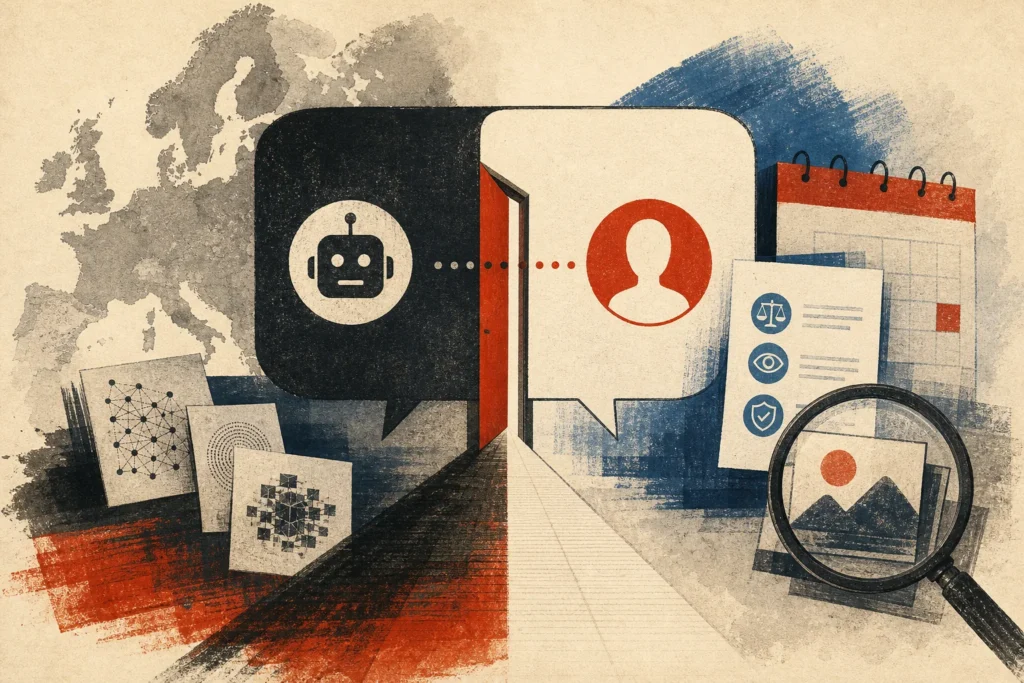
Checked 30 July 2026. The European Commission has now published final guidance for the AI Act transparency obligations that start applying on 2 August 2026. For people using companion chatbots, the useful question is not whether a policy page contains the word “AI.” It is whether an ordinary person can tell, at the moment it matters, that the conversational partner and generated media are artificial.
What the final guidance establishes
The Commission’s final Article 50 guidance was published on 20 July and the page was updated on 29 July. It says the rules cover defined transparency risks and are intended to support consistent application across the European Union. The companion-user part is straightforward in principle: when someone is interacting directly with an AI system, the system should inform them that the interaction is with AI unless that fact is obvious to a reasonably informed and attentive person.
The Commission’s reader-facing quick facts separates that interaction disclosure from duties around detecting or marking AI-generated material. It also describes a limited grace period for the marking-and-detection obligation for certain systems placed on the market before 2 August. That is not a general permission to hide the artificial identity of a chatbot, and it should not be presented to users as one.
The accompanying Code of Practice is voluntary, while the underlying Article 50 requirements are legal obligations. A provider may use the code to support compliance or demonstrate its approach, but a code badge would not by itself tell a reader whether a particular companion conversation is private, accurate, emotionally safe or easy to leave.
Six interface checks for 2 August
- Before the first reply: the product should identify the conversational system as AI before intimacy, roleplay or personal disclosure begins—not only in a footer reached later.
- During the conversation: the nonhuman status should remain easy to recover when a long session, voice call or emotionally intense exchange makes the interface feel more person-like.
- Around generated media: images, voices and video should have a clear origin signal. A user should not need forensic skill to distinguish product-generated media from a real person’s upload.
- Across characters: a persona name, biography or first-person style should not erase the underlying disclosure. “In character” is a creative layer, not a change of identity.
- At sharing points: downloads and share cards should preserve useful provenance where the product controls the export. A label that disappears outside the chat has limited value.
- At account exit: disclosure should be paired with accessible controls for memory, training use, export, cancellation and deletion. Transparency without agency is only half a control.
What a disclosure does not prove
A visible AI label does not validate a companion’s privacy claims, moderation quality, age assurance, model behaviour or wellbeing design. It does not show whether the app stores a transcript, uses it for model improvement, sends it to a service provider, retains a deleted memory or renews a subscription. Those remain separate evidence questions.
This distinction matters because companion products deliberately combine persistent personas, conversational memory, expressive voice and repeated contact. A system can be completely open about being artificial while still creating confusing expectations about confidentiality, affection or permanence. EmberGF therefore treats disclosure as the first test, not the final verdict.
A practical companion-user audit
Take screenshots only of non-sensitive interface states. Record where the AI identity first appears, whether it survives a voice or media flow, and how quickly you can find the privacy and exit controls. Then open the current policy documents and note their update dates. Do not paste private chats, identity documents or another person’s image into an audit.
Repeat the check after a major model or interface update. The Commission’s guidance is current, but products change continuously. A review that verified a disclosure in July cannot promise that the same placement, wording or export behaviour will exist months later.
What a responsible publisher should record
A useful review should preserve the date, locale, device class and exact public policy URL for each observation. It should say whether the disclosure was visible before signup, before payment, at the start of chat, inside voice mode and on exported media. If a check was performed only on a marketing page, the review should not imply that the logged-in product behaved the same way.
Corrections also need version boundaries. A provider may improve a disclosure after publication, or a regional rollout may make two accurate reports appear contradictory. EmberGF will distinguish the observed interface from the operator’s documentation and update a claim only when a dated source or reproducible check supports the change.
How this differs from our earlier disclosure story
EmberGF’s earlier design note on nonhuman disclosure explained why transparency must remain understandable during an emotionally intense exchange. This update is narrower and more time-sensitive: it records the final Commission material immediately before the 2 August application date and turns it into a repeatable user check.
Primary sources
- European Commission: final guidelines on transparency obligations (published 20 July 2026; page updated 29 July 2026).
- European Commission: quick facts on AI transparency rules (checked 30 July 2026).
- European Commission: Code of Practice on transparency of AI-generated content (checked 30 July 2026).
Editorial boundary: this is a user-facing reading of current primary sources, not legal advice or a compliance certification. It contains no affiliate link.