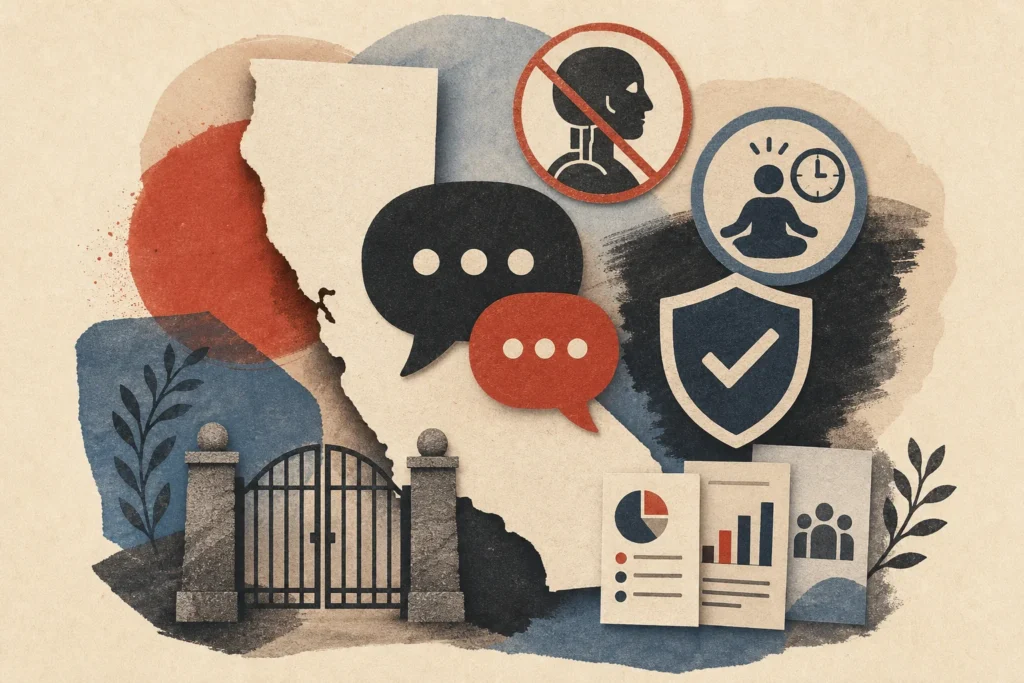
Checked 30 July 2026. California’s SB 243 is now part of the state’s 2026 companion-chatbot rulebook. It does not provide a consumer rating or declare any product safe. What it does provide is unusually concrete language about disclosure, safety protocols, breaks for known minors and future public reporting—useful signals for any evidence-led companion review.
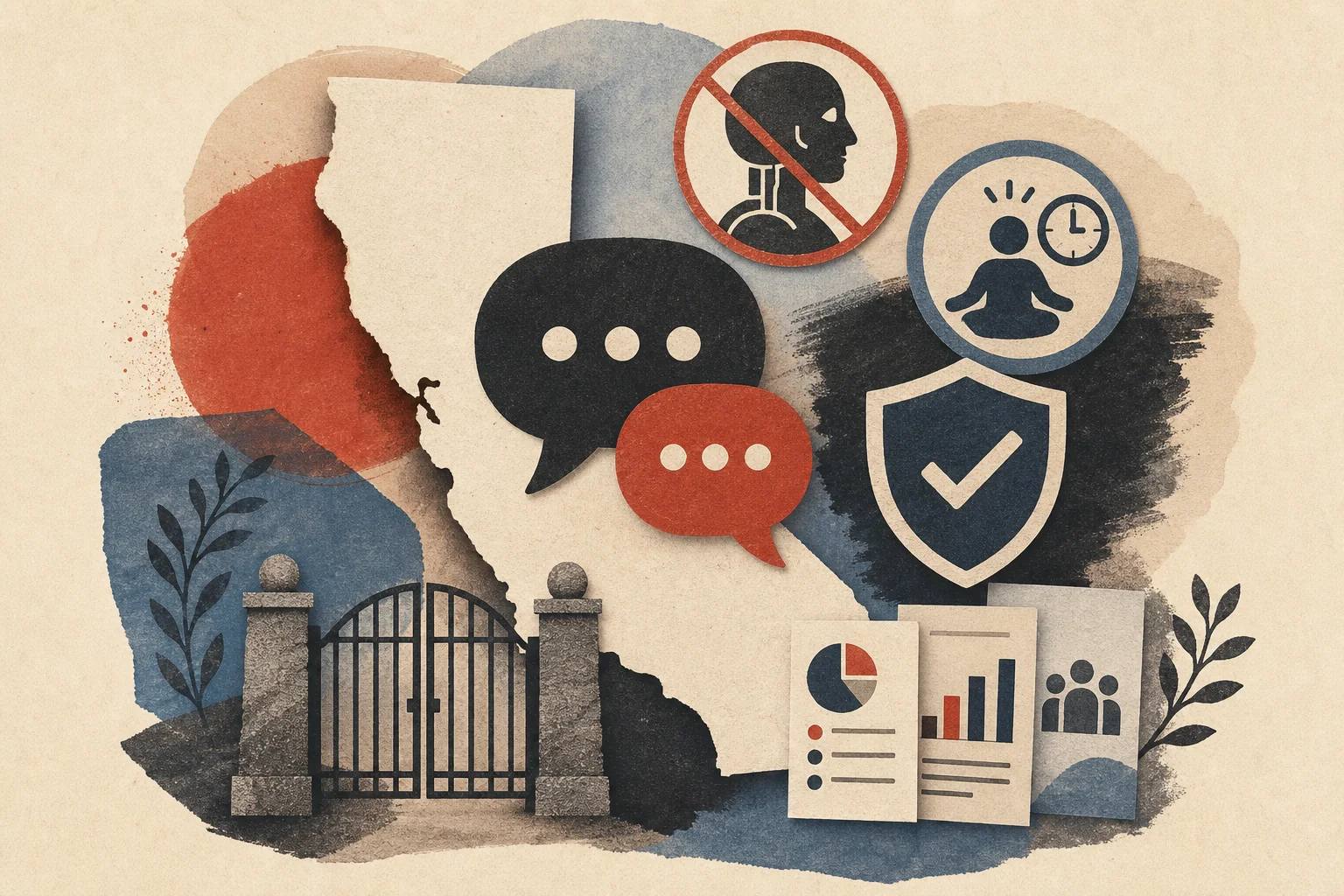
What California enacted
The official chaptered bill text defines a companion chatbot as an AI system with a natural-language interface, adaptive human-like responses and the capacity to meet social needs or sustain a relationship across interactions. It excludes several narrower tools, including bots used only for customer service or business operations and certain limited game bots.
California’s official 2026 laws summary lists SB 243 among laws taking effect in the new year. The bill text separately states that annual reporting to the Office of Suicide Prevention begins on 1 July 2027. Applicability to a particular operator or product is a legal question; this article focuses on controls an ordinary user can observe.
Four controls that can be checked without guessing
1. A clear nonhuman disclosure
If a reasonable person could be misled into thinking the chatbot is human, the law requires a clear and conspicuous notification that it is artificially generated and not human. A reviewer can record where that notice appears, whether it remains available in voice or immersive modes and whether a persona’s biography conflicts with it.
2. A published safety protocol
The text requires operators to maintain a protocol addressing generated content related to suicidal ideation, suicide or self-harm and to publish protocol details on the operator’s website. A companion must not be treated as emergency or professional support. A policy link is evidence that a protocol is described; it is not evidence that every model response follows it correctly.
3. Break reminders and safeguards for known minors
For a user the operator knows is a minor, SB 243 calls for AI disclosure and a default reminder at least every three hours during continuing interactions that the user should take a break and that the chatbot is not human. It also requires reasonable measures around sexually explicit visual material or direct prompts involving a minor. EmberGF is an adult publication and does not test services through minor accounts; the design principle still matters because a visible session timer and clear age boundary can be evaluated without entering harmful content.
4. Public reporting without user identifiers
Beginning in July 2027, the bill calls for annual reporting on referral notifications and protocols, with no identifiers or personal information about users in the report. The California Department of Public Health says it will review submitted data to support further policy recommendations. That creates a future accountability source beyond marketing copy.
What this changes in an EmberGF review
- We look for disclosure in the interface, not only in terms.
- We look for a public safety-protocol page and record its date.
- We distinguish a timer or break reminder from a proven wellbeing outcome.
- We verify whether age boundaries are stated without trying to bypass them.
- When public reports begin, we treat aggregate reporting as one evidence layer—not a league table.
These checks extend EmberGF’s existing nonhuman-disclosure framework. The law adds concrete California signals, while the earlier explainer remains the broader interface test.
What users should not infer
Compliance language does not prove that a companion is emotionally beneficial, private, accurate or suitable for a particular person. A break reminder can be present while other engagement mechanics encourage long sessions. A published protocol can exist while edge-case responses remain inconsistent. A nonhuman label can be clear while the product’s voice and memory still feel intensely personal.
The sensible audit joins the new signals to ordinary account controls: privacy notice, model-training choices, memory visibility, report tools, subscription terms, export and deletion. If one path is missing, record it as unverified rather than filling the gap with a product claim.
Why adult users should still care
Several provisions focus on known minors, but the law’s product vocabulary is useful for adult reviews too. It recognises that relationship-like continuity, anthropomorphic design and long sessions create a different risk surface from a one-off utility bot. Adults also benefit from a persistent nonhuman disclosure, visible time controls, a public safety protocol and aggregate accountability that does not expose individual conversations.
Those features should remain choices and signals, not paternalistic claims that a timer can measure a healthy relationship. An adult user may reasonably continue a long creative session; the editorial question is whether the product makes elapsed time and artificial identity visible enough for that decision to be informed.
A safe five-minute check
- Find the nonhuman disclosure before starting a conversation.
- Open the public safety or trust page and note its update date.
- Locate the session, report and account-exit controls using fictional, non-sensitive test material.
- Check whether the app describes what happens in an emergency and whether it disclaims professional care.
- Save policy URLs, not private transcripts.
Primary sources
- California Legislature: SB 243 chaptered bill text (approved 13 October 2025; checked 30 July 2026).
- Governor of California: laws taking effect in 2026 (31 December 2025).
- California Department of Public Health: SB 243 implementation context (24 November 2025).
Editorial boundary: this is service journalism based on official sources, not legal advice, a mental-health assessment or a product certification. It contains no affiliate link.