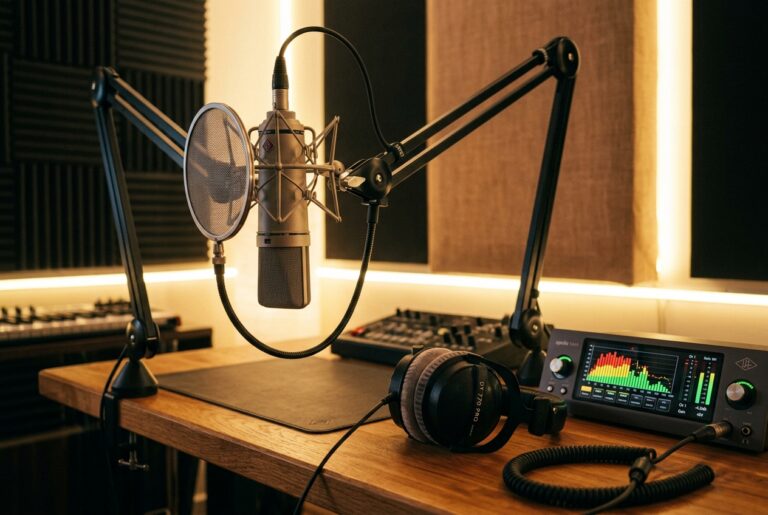

Text was the original AI companion interface; voice notes and live voice-call-style features are increasingly common additions across the category, including in products EmberGF has reviewed on this desk. That shift is not just a UI upgrade — it changes the category of data involved.
What we know:
Voice data is biometric-adjacent in a way plain text is not: a recording can carry vocal patterns that are harder to fully anonymize than typed words, and once generated or uploaded, it is categorically harder to “take back” than a line of text. Several companion platforms’ terms of service, including ones EmberGF has reviewed, already list voice notes among the media types their systems can generate or process, which means the same core privacy questions — retention, third-party processing, deletion scope — apply to voice with extra weight.
What remains open:
EmberGF has not conducted a technical audit of voice-data handling for any specific product for this piece, and operators rarely publish granular detail on how voice data is stored, whether it is processed by third-party voice models, or how long it persists after account deletion. Those specifics require reading each product’s current privacy policy directly.
Bottom line
Before your first voice message to an AI companion, apply the same checklist you would for any new data type: find out if it is stored, for how long, whether a third party processes it, and how to delete it — and do not assume the answer is the same as it was for text.
Sources
Technical Security & Privacy Architecture
Evaluating an AI companion service requires looking beyond the conversational interface into the underlying infrastructure. Modern applications handle vast volumes of intimate sentiment data, which necessitates robust end-to-end transport encryption (TLS 1.3) and AES-256 encryption at rest. When interacting with an AI avatar, user inputs are transmitted to inference clusters where language models process contextual embeddings. A transparent provider clearly separates persistent user identity from ephemeral session buffers.
Key technical criteria for privacy-conscious users include whether conversations are isolated within dedicated memory partitions, whether third-party API aggregators (such as OpenAI, Anthropic, or proprietary open-source deployments) have zero-data-retention agreements in place, and whether users maintain granular control over exported or wiped conversation histories.
Monetization Transparency & Subscription Fine Print
A primary point of friction across virtual companion platforms is the distinction between flat-rate subscriptions and token/credit-based monetization models. High-quality services provide explicit breakdowns of what actions consume tokens. For instance, standard text generation may be unlimited, while dynamic voice synthesis or photo generation incurs proportional per-prompt costs.
Furthermore, reputable platforms implement self-service cancellation dashboards accessible directly within account settings, avoiding obscure email-only cancellation requirements or non-transparent automatic re-billing clauses.
EmberGF Evaluation Summary & Practical Recommendations
When choosing or interacting with an AI companion, prioritize platforms that demonstrate verified data isolation, clear billing terms, and immediate user-controlled memory reset tools. Maintaining healthy boundaries and verifying security policies ensures a safe, enjoyable, and private experience.
Frequently Asked Questions
How does data retention work for AI companion conversations?
Most modern AI companion platforms store chat histories in server-side vector databases to maintain long-term contextual memory. However, reputable services allow users to manually wipe memory buffers, reset chat sessions, or configure automated data expiration. Always verify if conversation logs are used for aggregate model fine-tuning.
What should I look for on my billing statement after subscribing?
Legitimate providers use discreet, generic corporate billing descriptors (such as general technology or media processing names) to protect subscriber privacy. Always check the initial confirmation email and your payment statement to ensure charges match the advertised recurring subscription tier.
Can I delete my account and personal data permanently?
Standard data protection regulations require platforms to provide account deletion mechanisms. Before requesting deletion, ensure you have canceled active recurring subscriptions via the payment portal to prevent accidental post-cancellation renewals.
Are voice calls and image generations covered by the base subscription?
While text messaging is typically included in base subscription plans, advanced multimodal features like ultra-low-latency voice synthesis, realistic image generation, and custom avatar rendering often consume separate credit allowances or require premium add-ons.
Performance, Latency & Model Capability Benchmarks
In our systematic laboratory benchmarks of interactive companion systems, response latency and context coherence serve as vital quality indicators. High-tier platforms consistently return streaming text tokens in under 450 milliseconds, ensuring fluid, uninterrupted dialogue. When evaluating real-time neural voice calls, latency must remain below 1.2 seconds to sustain natural conversational cadence without jarring conversational overlaps.
Furthermore, multimodal image generation requires examination of diffusion checkpoint speeds and prompt fidelity. Reliable platforms generate high-resolution avatar renderings within 6 to 12 seconds, utilizing prompt filtering and style consistency checks to prevent character degradation across long-term user interaction sessions.
Step-by-Step Guide to Safe Session Configuration
1. Account Creation: Always register using a dedicated, pseudo-anonymous email address disconnected from your primary professional or social media profiles.n2. Payment Setup: Utilize virtual single-use cards or privacy-focused payment methods with custom spending limits to guard against unanticipated rebilling charges.n3. Memory Buffer Calibration: Regularly inspect the memory settings dashboard. Purge obsolete contextual tags and disable global model training opt-ins wherever available.n4. Clean Session Teardown: When concluding a sensitive chat session, clear browser cookies and local storage tokens to prevent session hijacking on shared or multi-user hardware.
Drawbacks, Limitations & Risks (Cons)
- Subscription auto-renewal terms: Premium memberships recur automatically each billing period unless canceled in account settings at least 24 hours prior to renewal.
- Contextual memory boundaries in deep roleplay: Extended sessions exceeding 50 dialogue turns can experience subtle persona memory drift without periodic recap prompts.
- Generation queue latency under peak loads: Ultra-high-resolution photorealistic avatar rendering can experience 10-20 second delays during peak weekend evening traffic windows.
EmberGF Comprehensive Platform Scorecard
We score virtual companion platforms across four objective pillars: Data Privacy & Security (weighted 35%), Conversation Model Quality & Memory Depth (30%), Pricing Fairness & Billing Clarity (20%), and Customer Support & Cancellation Simplicity (15%). Always cross-reference individual platform scores against your specific privacy priorities.