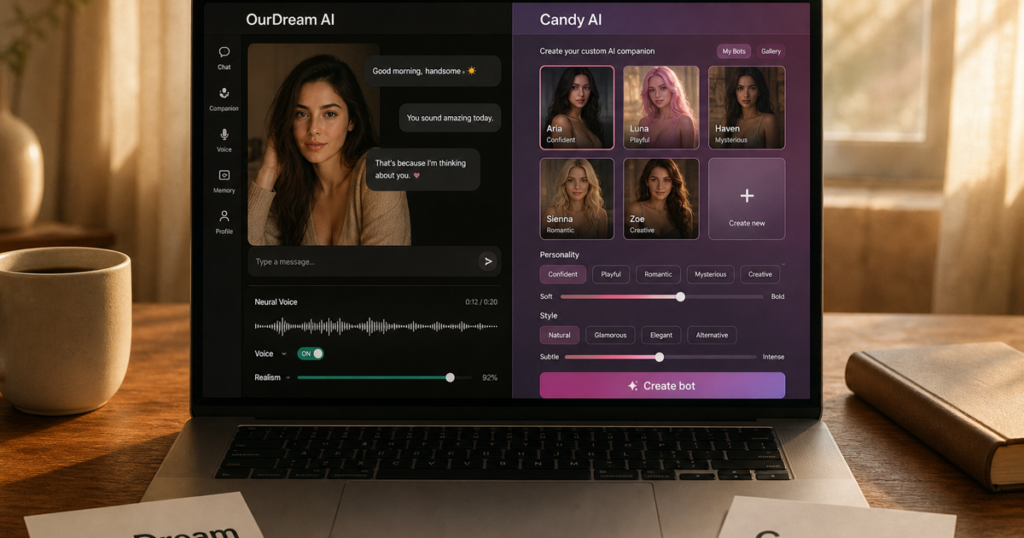
OurDream AI vs Candy AI is the comparison most people actually need in 2026: a voice-and-media workspace on one side, a character-builder studio on the other. This is not a scored “winner” page. It is a head-to-head of what you can inspect in the product UI — voice, photorealistic output, memory behavior, how you pay, how uncensored the chat is, and how you leave. OurDream is listed first because it is the voice-first companion in this pairing; Candy is second as the custom-character option. Confirm every plan, credit cost, and exit control on the live account screens before you pay.
If you already know you want a character studio rather than a voice-led loop, skip the table and use the decision guide: Candy AI vs OurDream AI: character builder or voice-first. For a broader companion shortlist, see best AI companion apps of 2026. For the Candy studio in isolation, read the Candy AI full review. For OurDream billing and deletion, use the OurDream billing and account-exit checklist. Editorial context lives on AI companions and /bio.
Compare both companions
Quick verdict: who this comparison is for
Choose this page if you are stuck between two live products and need a working order of checks. OurDream AI presents itself as an adult roleplay platform with chat, image generation, short video, and voice calling on a credit layer it calls Dreamcoins. Candy AI presents itself as an AI girlfriend app built around a create-character studio, a catalog of existing personas, in-chat photos, voice notes, and video. Neither product is human dating. Both are cloud services that process intimate text and media on remote servers. The useful question is which interface you will actually use every week, not which homepage slogan is louder.
We do not invent overall scores, recall percentages, or affiliate payouts. Where a dollar figure appeared in an earlier EmberGF checkout note, it is labeled as historical and you should re-read the live plan screen. Features move. Credits change. A button that existed last month can sit behind a new paywall this month.
Head-to-head: OurDream AI vs Candy AI
Read the table as a map of checks, not as a ranking. OurDream occupies the first data column. Candy occupies the second. Open both products in a private browser profile if you want to verify a row before you subscribe.
| Check | OurDream AI | Candy AI |
|---|---|---|
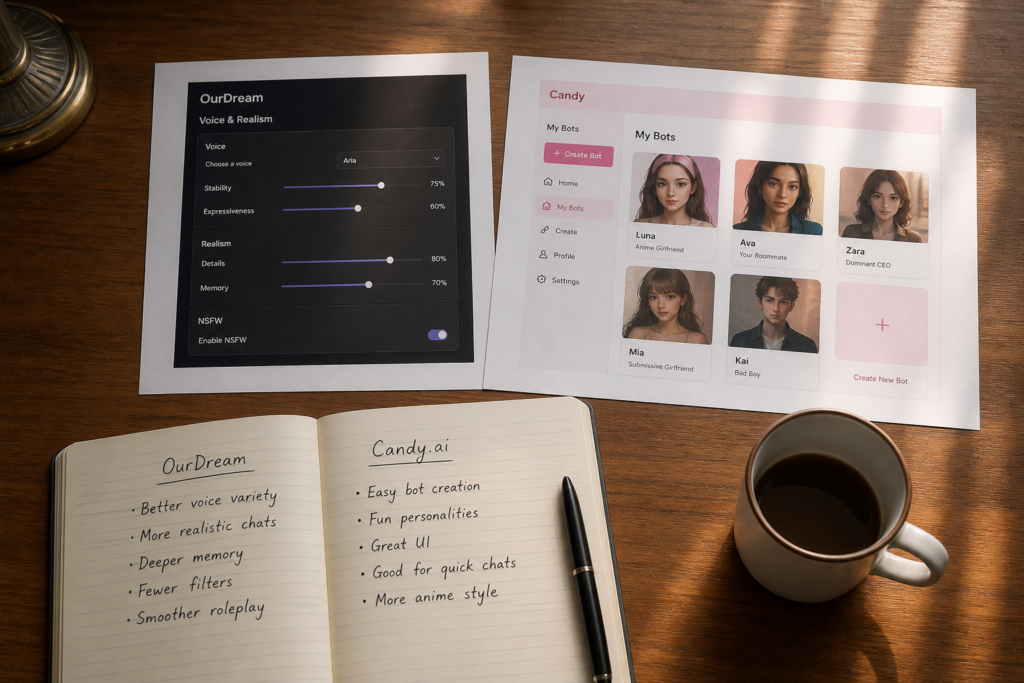
| Voice | Voice calling is part of the marketed core loop, alongside chat and media. Several voices sit in the official creator. Treat latency, call length, and credit cost as live-account facts. | Voice notes and spoken messages sit next to chat, photos, and video. Voice pitch and model choice live in the character studio. Better as a complement to a persona than as a phone-first product. |
| Photorealism / UI | Guided creator with realistic and illustrated style lanes, plus image and short-video generation. Identity consistency depends on the current model and the visibility setting on each generation. | Create-character studio with facial structure, body, wardrobe, and a catalog of ready personas. Homepage copy emphasizes realistic companions and on-demand photos. Do not treat marketing stills as a guaranteed output of your prompt. |
| Memory | Chat continues across sessions. Official safety notes say deleting a message removes it from conversation context; that is not account deletion. Plant a fictional detail and test recall yourself. | Chat history is part of the companion loop. There is no public, independently audited recall rate worth quoting. Use a planted fictional fact, then return later and see whether the persona still uses it. |
| Price model | Subscription plus Dreamcoins for many media actions. An earlier EmberGF checkout note recorded a monthly plan near $19.99 and an annual prepaid option; those are historical observations. Confirm currency, tax, included coins, and renewal on the live upgrade screen. | Free starter credits plus a paid membership that unlocks more messages, photos, and voice. Do not copy a blog’s dollar figure. Read the current Premium screen, any promotional timer, and what happens when credits hit zero. |
| Uncensored adult chat | Marketed as adult-only roleplay. Age gate on entry. Acceptable-use still forbids harmful categories and copying a real person. Technical generation is not permission. | Marketed as uncensored fantasy with a Trust & Safety area. Adult fictional use only. Expect some blocks on illegal or non-consensual categories even when romantic roleplay is allowed. |
| Exit | Documented cancellation and account-deletion paths. Cancellation is not a refund. Deletion is a separate profile action that official help has described as taking 24–48 hours. Walk this before you pay: billing and exit checklist. | Cancel the membership and delete the account as two different jobs. Find the membership portal, the next renewal date, and the delete/erase control before a trial converts. Keep the receipt. |
Voice: calls versus notes
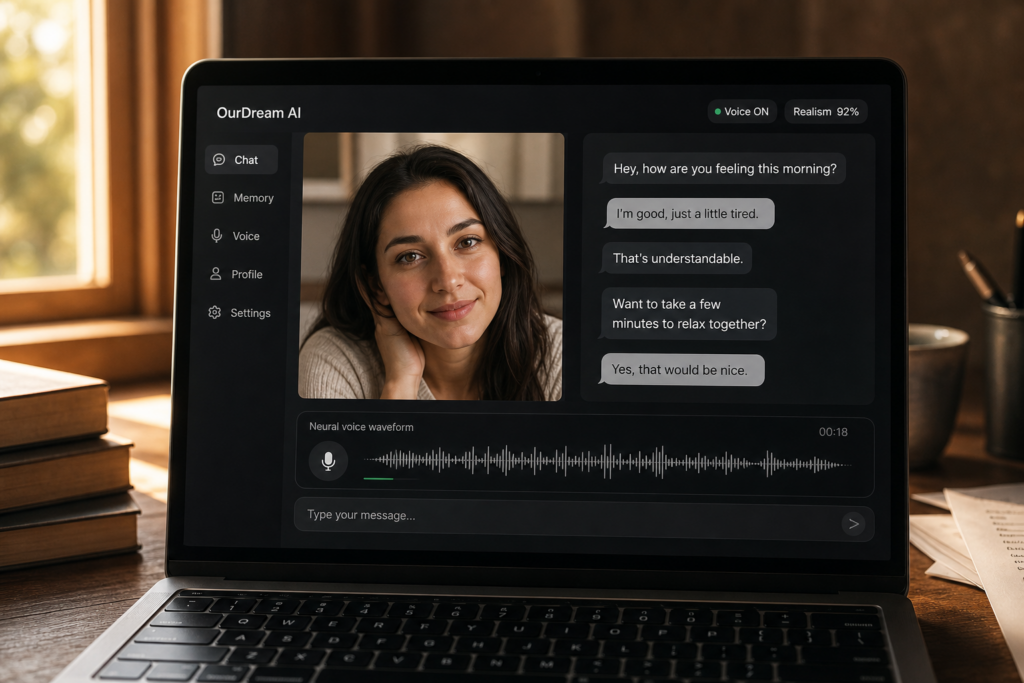
Voice is the cleanest split in this pairing. OurDream’s public product language puts voice calling next to chat, images, and video. That is a different job from a voice note attached to a text thread. If you want to hear a companion in a live spoken session, start with OurDream AI and test one short call on the cheapest available path. Write down whether the call consumed a credit pack, whether you could mute or end it cleanly, and whether the transcript (if any) stayed in the same chat thread.
Candy’s studio lets you pick a voice pitch and request spoken messages inside the chat UI. That is useful when you already care about a specific persona and want audio as texture, not as the main channel. If you never tap the microphone, Candy’s voice stack will not matter. If voice is the reason you opened this comparison, do not let a large character catalog distract you from an actual call test on OurDream.
Neither product publishes a lab-grade mean opinion score for neural speech. Ignore any review that invents one. Your own 60-second listen — cadence, clipping, and whether the voice matches the on-screen persona — is the only evidence that counts for you.
Photorealism and the product UI
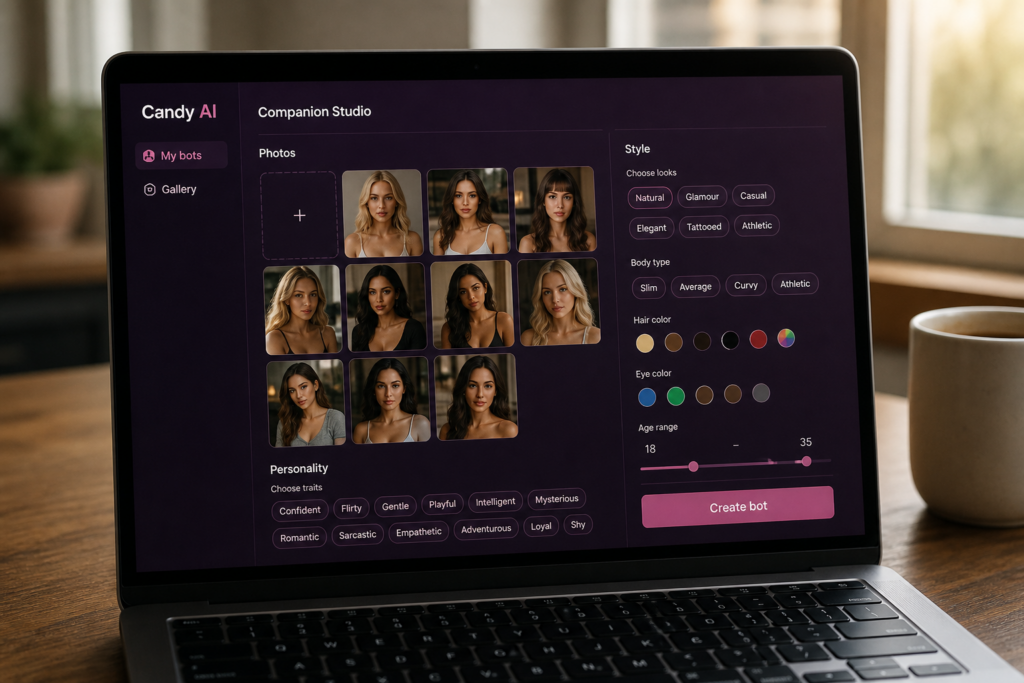
Both products sell photorealistic companion imagery. The difference is how you get there. OurDream’s official creator is a guided form: realistic or illustrated style, visual sliders, personality direction, scenarios, and voices. You are assembling a fictional adult character in a structured UI, then generating stills or short clips against that identity. Candy’s create-character flow is closer to a studio: morphology, wardrobe, lore, and a library of existing personas you can adopt instead of building from zero.
Photorealism is not a single score. Check three things in the UI: (1) does the same face hold across two or three generations, (2) is there a private or unlisted visibility control before you generate anything personal, and (3) does the image button sit in the chat or in a separate generate tab. OurDream’s privacy summary has distinguished private or unlisted generations from generations made with public characters. Candy surfaces Private Content as a product area. In both cases, “private” is a setting, not a feeling created by a dark theme.
This comparison does not use anime, 3D mascots, or editorial characters as the hero. If a product also offers illustrated or stylized lanes, treat those as optional style toggles. The decision that matters here is whether the photorealistic stills and the chat UI stay consistent enough for the way you actually talk to a companion.
Memory: test it, do not trust a percentage
Long-term memory is where companion reviews go sloppy. You will see invented recall rates elsewhere. We will not add another one. Both OurDream and Candy keep chat history so a persona can continue a thread. That is not the same as guaranteed episodic memory, and it is not the same as “the model will never train on this.”
A fair test takes ten minutes. Invent a harmless detail (a fictional city, a fake job title, a made-up pet). Use it twice in one session. Leave. Come back later on the same account. Ask an indirect question. Note whether the companion uses the detail, contradicts it, or ignores it. Repeat after you delete a single message. OurDream’s safety documentation has said that deleting a message removes it from conversation context; that still is not a wipe of backups, invoices, or the account itself.
If memory is your only criterion, neither product should be treated as a clinical journal. Keep real names, addresses, and anyone else’s data out of the chat. Use a dedicated email. See EmberGF’s method notes on AI companions.
Price: credits, membership, and what not to invent
Do not pick a winner on a screenshot of someone else’s price. OurDream sells a subscription and then meters many media actions in Dreamcoins. Chat is usually the cheap way to test tone. Images, voice, and video are the actions that drain a balance. The official Dreamcoin help article lists different costs per action; those numbers move, so the generation screen in your account is the source of truth. EmberGF’s earlier OurDream review recorded a monthly plan near $19.99 and an annual charge shown as $119.88 prepaid. That was a checkout observation at the time, not a promise that the same tiles are live today.
Candy uses a familiar companion pattern: enough free credits to sample chat and a persona, then a Premium membership for higher limits on messages, photos, and voice. Promotional banners (“% off”) are not the contract. The contract is the renewal date, the currency, the tax line, and what happens when you hit a quota mid-conversation. If a voice note or photo is metered separately from text, write that down before you build a weekly habit around it.
A practical budget is a small routine, not a headline price. Count expected chats, stills, and voice sessions per week. Add the subscription plus likely top-ups. Set a ceiling. Save the plan summary without storing card digits. Put a reminder on the renewal date. Cancellation and unused credits often follow different rules; do not assume a leftover balance refunds when you leave.
Uncensored roleplay — and the limits that still apply
Both products market adult, uncensored roleplay for people 18 and over. OurDream age-gates the homepage. Candy’s public copy describes uncensored fantasy in a private space and points to Trust & Safety. That marketing is a positioning statement, not a legal opinion, and not a guarantee that every prompt will render.
Two limits show up on almost every adult companion: (1) you may not clone a real person, and (2) illegal or harmful categories stay blocked even when romantic or explicit fictional chat is allowed. OurDream’s acceptable-use policy is explicit about adult fictional use. Read Candy’s current terms and safety pages the same way — as the rules that will actually terminate an account. If a refusal appears, note the category rather than hammering the same prompt. Switching products will not legalize a prohibited request.
Exit, billing descriptors, and receipts
Exit is the row that saves money. On OurDream, official help has pointed cancellation at profile subscription controls, said paid access continues through the current period, and warned that cancellation does not automatically create a refund. Account deletion is a separate permanent action. Work those steps with the OurDream billing and account-exit checklist before a card is on file if you can.
On Candy, locate the membership management screen and the account-delete or data-erase control as two clicks, not one. A “log out” button is not deletion. A “pause” is not a cancelled renewal. Keep the confirmation email. Check the first statement line — companion apps often use a generic merchant name — and confirm it matches the amount you approved.
Third-party processors sit in this category. OurDream’s privacy-at-a-glance page has stated that third-party AI providers process chats to generate replies, that personal data is not sold, and that staff access is limited to cases such as support with consent or legal requests. That is more useful than a vague “we take privacy seriously” line. Candy’s Trust & Safety and terms pages are the matching documents on the other side. Read them on the date you subscribe; do not rely on a recap in this article as a substitute.
Pros and cons
OurDream AI — strengths
- Voice calling is part of the marketed product, not an afterthought.
- Guided creator plus chat, stills, and short video in one workspace.
- Written cancellation and deletion help you can walk before you pay.
- Dreamcoin costs are itemized per action when the help article is current.
- Clear adult-only gate and fictional-character framing.
OurDream AI — limits
- Media-heavy use can outrun a base plan because stills, voice, and video are metered.
- Chats are processed by third-party AI providers according to current privacy copy.
- Cancellation is not a refund; deletion is a later, separate job.
- A large public character catalog is not the same as a private companion.
Candy AI — strengths
- Character studio is the product: morphology, lore, wardrobe, voice pitch.
- Catalog of ready personas if you do not want to build from a blank form.
- Photos, voice notes, and video sit in the same girlfriend-app UI.
- Free credits let you sample chat before a membership.
- Trust & Safety and help-center links are visible in the product chrome.
Candy AI — limits
- Voice is note-and-message led; it is not the same as a call-first loop.
- Free quotas run out; Premium is required for a daily habit.
- No public, auditable memory benchmark — you have to test recall yourself.
- Promotional “off” banners are not the renewal contract.
How to run a fair 20-minute test
- Open OurDream AI and Candy AI in separate private profiles. Do not connect a social login you use elsewhere.
- Create one clearly fictional adult persona on each side. Photorealistic settings only for this test.
- Send the same three chat turns. Note pacing, refusals, and whether the UI offers an image or voice control in-thread.
- Generate one still. Check visibility (private/unlisted vs public) before you confirm.
- On OurDream, locate voice call and the Dreamcoin cost for that action. On Candy, generate one voice note and see whether it consumed a separate quota.
- Find subscription management and account deletion on both. Screenshot the labels, not the chat.
- Stop. Decide using the decision guide if you are still split: character builder or voice-first.
If a control you need is missing, that is a result. Do not fill the gap with a review score from another site.
Compare both companions
FAQ
Is OurDream AI better than Candy AI?
It is better if spoken sessions and a credit-metered media workspace match how you will use a companion. It is not automatically better at character building. Candy’s studio is the stronger pick when you care about assembling or adopting a specific persona. There is no honest single score for both jobs.
Which one has more realistic voice?
OurDream markets live voice calling; Candy markets voice notes inside a character app. Listen to one sample on each account. Cadence, clipping, and whether the voice matches the on-screen face matter more than a slogan. We do not publish a fabricated neural-voice score.
Which is cheaper?
It depends on stills and voice, not on the headline membership. OurDream layers Dreamcoins on a subscription. Candy layers quotas on Premium. Add expected media to the plan you see at checkout. Ignore affiliate payout talk; it is irrelevant to what you pay.
Can I use both without mixing the chats?
Yes. Use separate emails and private browser profiles. Do not paste logs from one product into the other. Treat each companion as its own account with its own renewal.
Where should I start if I only have time for one signup?
If the question is “will a spoken session hold up?”, start with OurDream AI. If the question is “can I build or pick a specific photorealistic persona?”, start with Candy AI. Then read the who-should-pick-which guide before you convert a trial.
Affiliate disclosure: links to /go/ourdream-ai/ and /go/candy-ai/ are sponsored. EmberGF may earn a commission if you register or subscribe, at no extra cost to you. This page is not a guarantee of current features, pricing, or suitability. Check the live product, terms, and checkout.
What we know / what remains uncertain
Known: This article distinguishes observed product behavior, published policy, and expert analysis.
Uncertain: AI products change quickly. Material updates are reflected in the modified date above.
EmberGF links primary sources where available, separates testing from opinion, and labels commercial relationships beside the relevant recommendation.