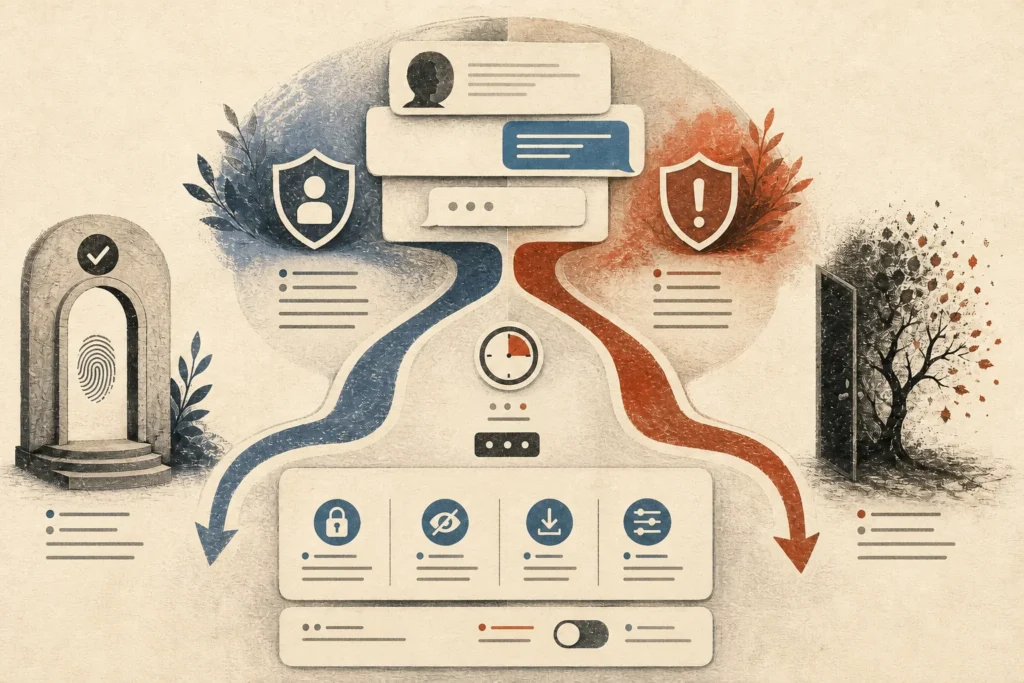
Checked 30 July 2026. Character.AI’s public documentation now gives adult users several concrete things to inspect: a redesigned memory area, an adult/under-18 experience split, a regional model-training choice, privacy rights and an account-deletion path. This review assesses those documented controls. EmberGF did not subscribe, create a sensitive persona or run long-term private chats, so it does not score conversation quality or safety outcomes.
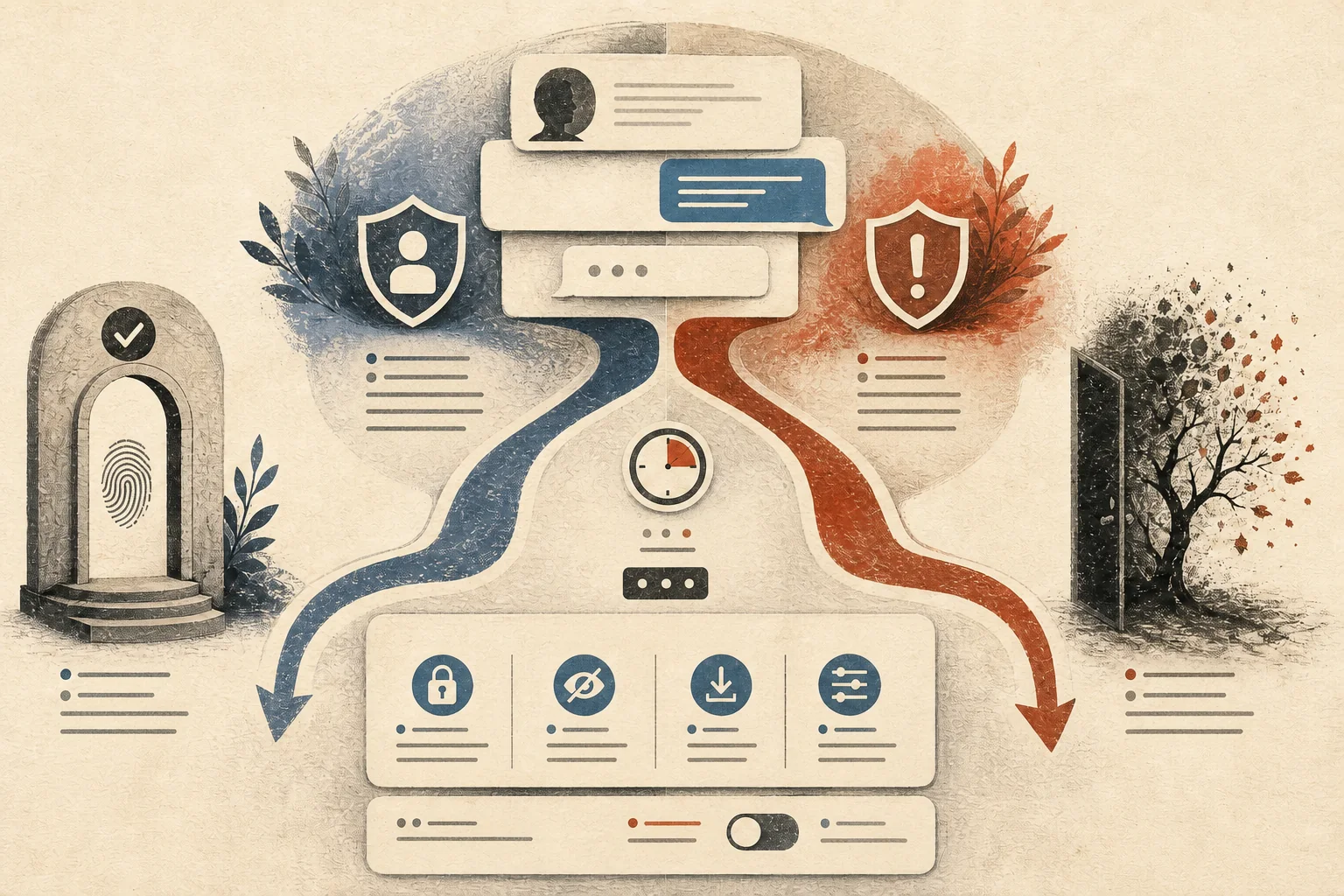
What changed in 2026
Character.AI’s April 2026 product update describes new model versions and a refreshed Memory page. The company says the system can track more categories of detail and now displays a notification in chat when a memory is recorded. It also announced memory-visualisation and “Remember this” work as coming features. Those forward-looking items should not be treated as universally available until they appear in a specific account.
For a privacy-conscious adult, the important part is not a claim that memory is “better.” It is whether the user can see what has been recorded, correct or remove it, understand its scope and avoid feeding it information that should never become a persistent profile. EmberGF did not test those actions, so the current UI remains an account-level verification step.
Adult chat and the under-18 product path are intentionally different
Character.AI’s 21 November 2025 rollout update says it began removing open-ended chat for under-18 users in the United States on 24 November, with other markets intended to follow. The same announcement describes a teen experience built around non-chat features such as Feed, Imagine, Avatar FX and Streams. Because it describes a staged rollout, it should not be stretched into a claim that every market completed the change on the same day.
The current Safety Center remains useful for the operator’s wider moderation and age-assurance framework. This EmberGF review is for adults and does not test a minor flow. It does not assume that age assurance is error-free, and it does not generalise an adult open-ended chat test to the under-18 product path.
What the training documentation says
Character.AI’s March 2026 training-data document lists public data, user text and interaction data, internally generated safety and testing data, synthetic data and third-party commercial sources among the data used for generative-system development. It says some data may include personal information as defined in California law and describes filtering processes.
A separate model-training settings guide tells EEA and UK users how to switch off “Improve the Model for Everyone.” It says the choice applies to new chat content used to train generative models, while feedback and some data use for search, recommendations and safety classifiers may continue. That is a meaningful control, but it is not the same as deleting earlier content or closing an account.
Memory quality is not memory governance
A companion can remember a preference accurately and still give the user too little control over why it was retained, how long it persists or where it is reused. Conversely, a visible memory panel can improve agency even when the conversational model occasionally forgets. Reviewers should score those as separate questions: recall accuracy, visibility, editability, deletion and downstream use.
The April announcement says a notification appears when memory is recorded. A proper live test would check whether that notice is consistent across web and mobile, whether the stored item can be corrected, and whether removing it changes later conversation. Until those actions are reproduced, the announcement supports a feature claim—not a verified privacy outcome.
EmberGF’s adult-AI memory test provides a reusable fictional-data protocol for that live check. It should be used before a long-running persona is given real names, health details or private images.
Privacy and exit are separate tests
The privacy help page summarises collection of account information, interaction data, usage data, IP address and some connected-service information. It describes purposes including operation, personalisation, support, model improvement, security and legal compliance, and notes that regional rights can include access, correction, deletion, restriction or portability.
The account-deletion guide describes deletion as permanent. On the web it points through Profile Settings, Account and Manage Account & Data; on mobile it points to Remove Account. EmberGF did not complete this irreversible action, measure retention or verify an export, so operational completion remains untested.
Deletion is also distinct from emotional and subscription exit. EmberGF’s clean-exit guide keeps those steps separate and avoids using private chat content as a support record.
A low-risk adult review protocol
- Create no public character and use a fictional identity with no link to real profiles.
- Open Memory before the first substantial chat and record what controls are visible.
- Use two harmless preferences and one boundary; later check what is remembered, invented or contradicted.
- Open the training setting if it is available in your region and distinguish that choice from feedback, deletion and search personalisation.
- Find data access, export and account deletion before making the conversation intimate.
- Stop if the interaction feels distressing or compulsive; a product session is not care.
EmberGF verdict
Character.AI publishes more control documentation than a feature-only review might suggest, and the 2026 memory notification is a useful direction because invisible memory is difficult to audit. The limitation is equally important: documentation cannot establish how consistently memory, moderation, age assurance or deletion works in a reader’s live account.
- Documented: 2026 memory changes; the announced removal of under-18 open-ended chat and a separate teen product path; data sources for model development; a regional training-use control; privacy rights; an account-deletion route.
- Not independently tested: paid features, memory accuracy, age assurance, moderation edge cases, export completeness, deletion completion or retention.
- Best first move: inspect Memory and Data & Privacy with fictional material before building a long-running persona or relationship.
Primary sources
- Character.AI: April 2026 model, memory and Lorebook update (14 April 2026).
- Character.AI: rollout update on the under-18 experience (21 November 2025).
- Character.AI Safety Center (checked 30 July 2026).
- Character.AI Training Data Documentation (updated 11 March 2026).
- Character.AI model-training settings guide (checked 30 July 2026).
- Character.AI privacy help page (checked 30 July 2026).
- Character.AI account-deletion guide (checked 30 July 2026).
Commercial status: this documentation-led review contains no affiliate CTA. Official links are evidence, not endorsements.